Andy's Robot Blog

words generated by wetware - all views are personal not representative of AMP Ltd

Blog Posts
Translating Einstein

Read the post

Translating Einstein

On the first of January 2026, Einstein's work went into the public domain - on publishing a translation of Einstein's' previously untranslated papers!

Knock-out Kit-out!

Read the post

Knockout kit out!

Engineers love kit, and we love getting great kit - some of our choices of equipment for design

ARIA Seed Creators

This is a link

ARIA Seed Creators

We are ARIA Seed Creators - Endorsed as thought leaders by the governments moonshot science R&D agency

Modular Robotics

Read the post

Modular Robotics!

We've been raving about modularity in robotics, at last we are starting to be able to reveal our embedded-digital-twin tech.

Starting a Company

Read the post

Starting a Company

This post is about the process that leads people on the road to building a company.

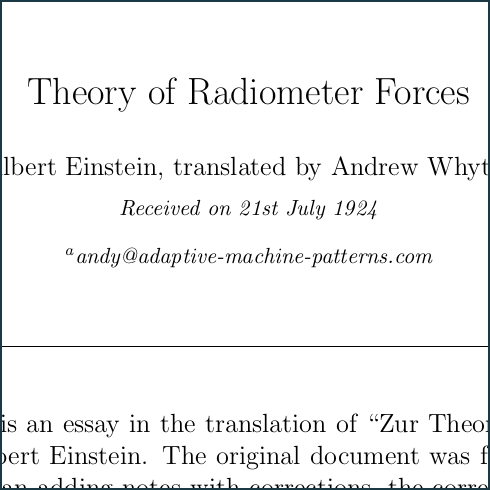
Einstein Translation


The Theory of Crookes Radiometers was solved by Einstein in 1924 -
but his paper was never translated into English... untill now!

A Crookes Radiometer is a scientific device (often looking a bit like a lightbulb) with a number of mobile vanes, colored black on one side, and reflective on the other. Inside the glass is a partial vacuum, that enables the effect where light appears to 'push' the vanes around. Interestingly for the Victorians, the vanes move in the opposite direction from the way you'd expect if light had mass.
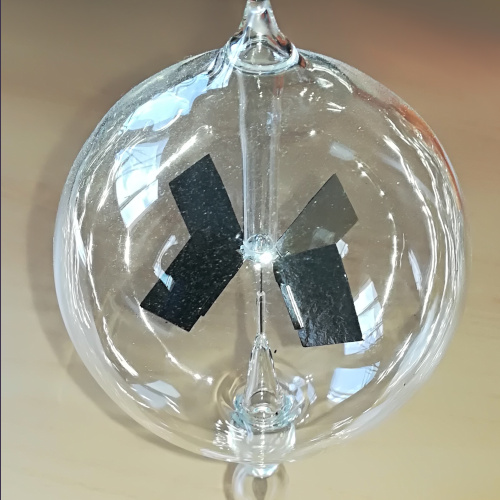


During my PhD I became interested in Crookes Radiometers, specifically I wondered if you could build something that did the same thing with Neutrons - effectively creating a potential route to micro or nano neutron flux powered systems.

The story is quite fascinating. It turns out that the Victorians were really interested in these devices (now mainly known as "that thing that hangs in your Granny's window"). With giant names in science like Maxwell and Reynolds slugging it out over the pages of academic journals - both had theories that lined up with parts of the observations, but neither quite had the whole picture. As is often the way with the big ego's of science, it got pretty personal! Maxwell wrote a fairly rude review of Reynolds work and in the end, the final repost by Reynolds was never published out of respect for Maxwell after his passing!

Then came Einstein, and in his typical way he simply solved the whole concept in one fell swoop! His paper is a tour-de-force, it can be understood by someone with A-level(high-school) maths (math) and yet explains a previously unknown phenomena (which would later be known as the Knudsen pump) Everyone breathed a sigh of relief and science moved on. The process is not covered by the Navier-Stokes equations and it has tended to be ignored in subsequent thermodynamics literature which seems to like the pretty pictures generated by Navier-Stokes! Leaving these little devices as nothing more than a curio.

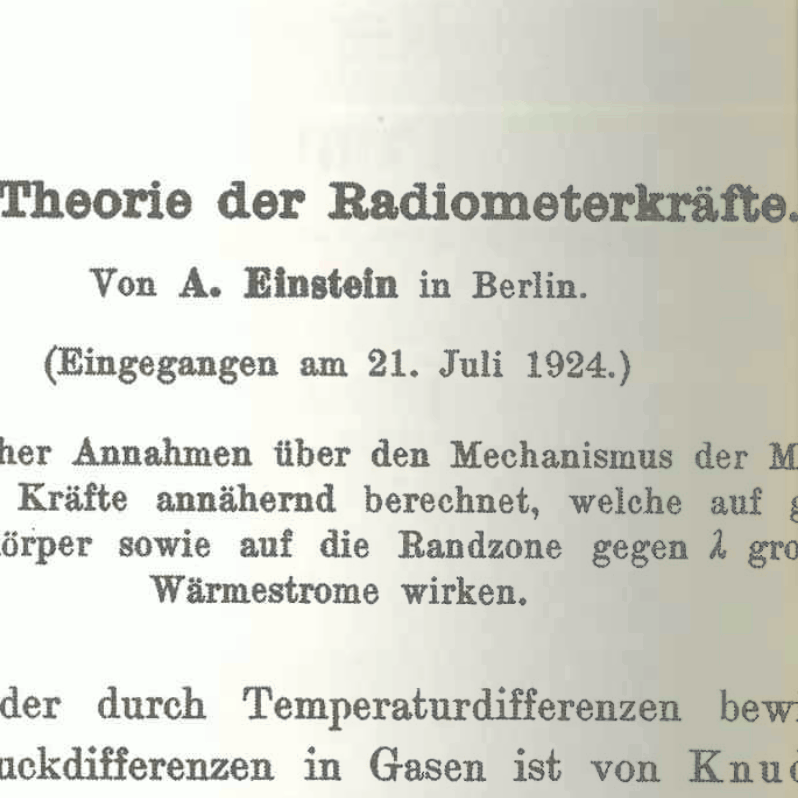
As a good PhD student (or one who'd drunk too much coffee) I tried to always trace my sources. Einstein's original paper was published in 1924 in "Zeitshrift für Physik BDXXVII", its easy enough to find papers that reference it. It turned out to be alot harder to actually find the paper! Einstein's estate were notoriously careful to protect it, and so I eventually found a paper copy in Trinity college library! I was pretty excited and made a copy of the original German [zip]!


In order to understand the work, I made a translation of the Einstein paper into English - As far as I can tell, this paper was never translated before! This was in 2019, but on asking at my university library I was advised that the translations were considered derivative works and I couldn't publish my translation without the permission of his estate... until 2026 (70 years after the death of the great fellow) when his words would be in the public domain. So here we are, I am in the clear!

I am not a great physicist, but I do enjoy Einstein, his explanation of Special Relativity is so simple, yet so far reaching. General Relativity is also somewhat accessible (although I haven't read the hard maths yet!). This paper is also a great example of science in action - in it basic tools, nothing more difficult than trigonometry and vectors are used to explain a previously unexplained phenomena. It is truly an honour to read this paper and an inspiration that he can reach forward in time over a hundred years.

There you have it, a previously unpublished Einstein translation ... in my next post, I will use the principle of the Crookes Radiometer to generate a novel method of harvesting neutron energy - watch this space! :D


Knock-Out Kit-Out
What equipment does a small company need to do interesting work in the area of product development and Robotics in 2026? Its been a tough year, but one thing that we are proud of is our setup and the equipment that we have chosen. Things that we consider when buying equipment are

Factors:
  • ⚬ The best tools
  • ⚬ Avoid proprietary, single-solution or Cloud reliant hardware
  • ⚬ Right-to-repair
  • ⚬ Open hardware
  • ⚬ space vs utility


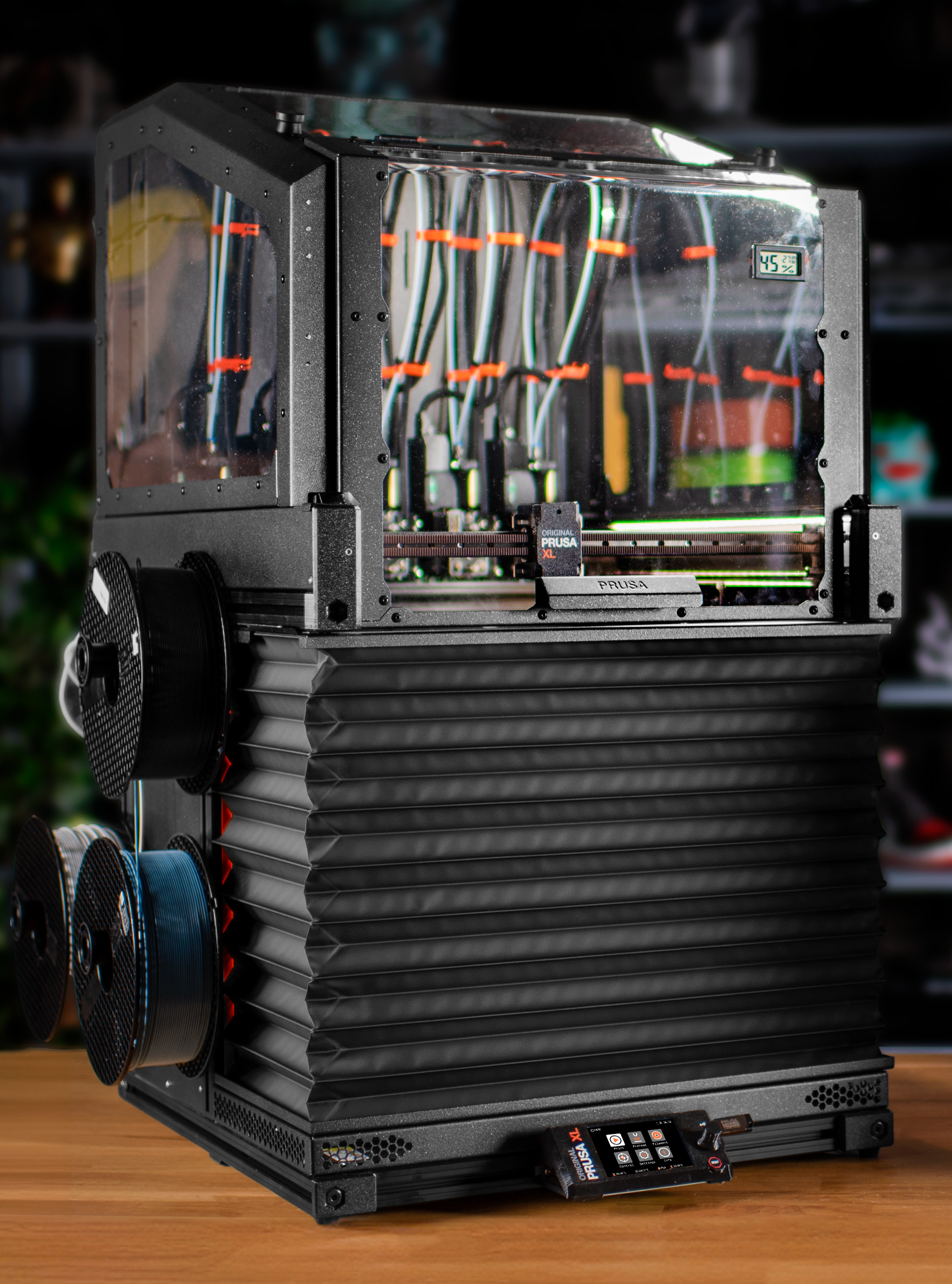
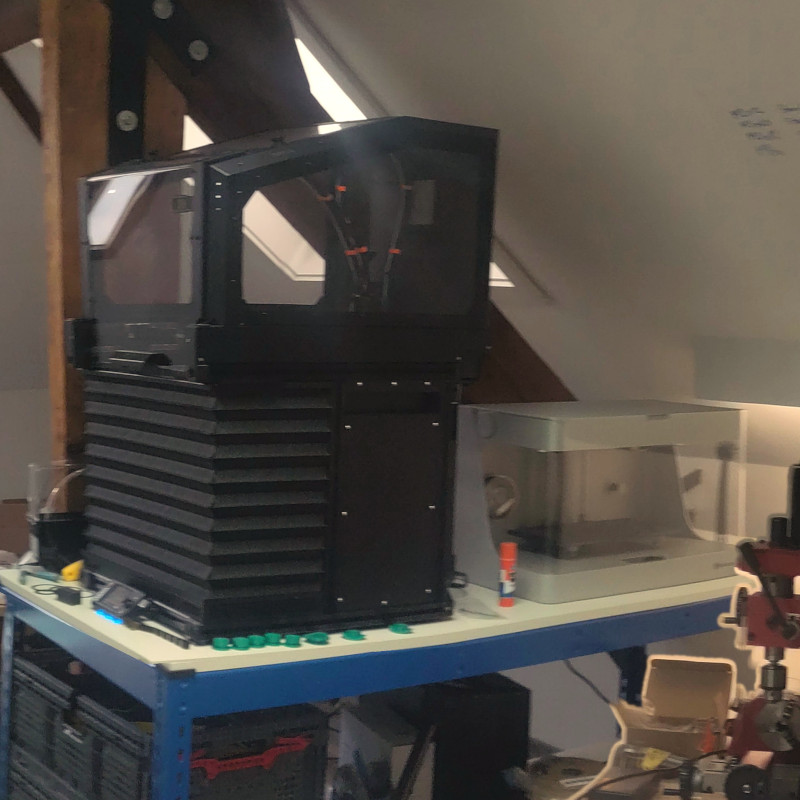
The PrusaXL is a great workhorse 3D printer

With that in mind, we have a couple of workhorses and some equipment so specilised that the above rules get broken. A great example is ...

3D Printers
Here we got a Prusa XL twin extruder - this product embodies the spirit of open source hardware, it is great, and the dual head makes interesting possibilities around materials possible. Then we also have a Markforged Mark II


ARIA Seed Creators

ARIA Seed Creators!


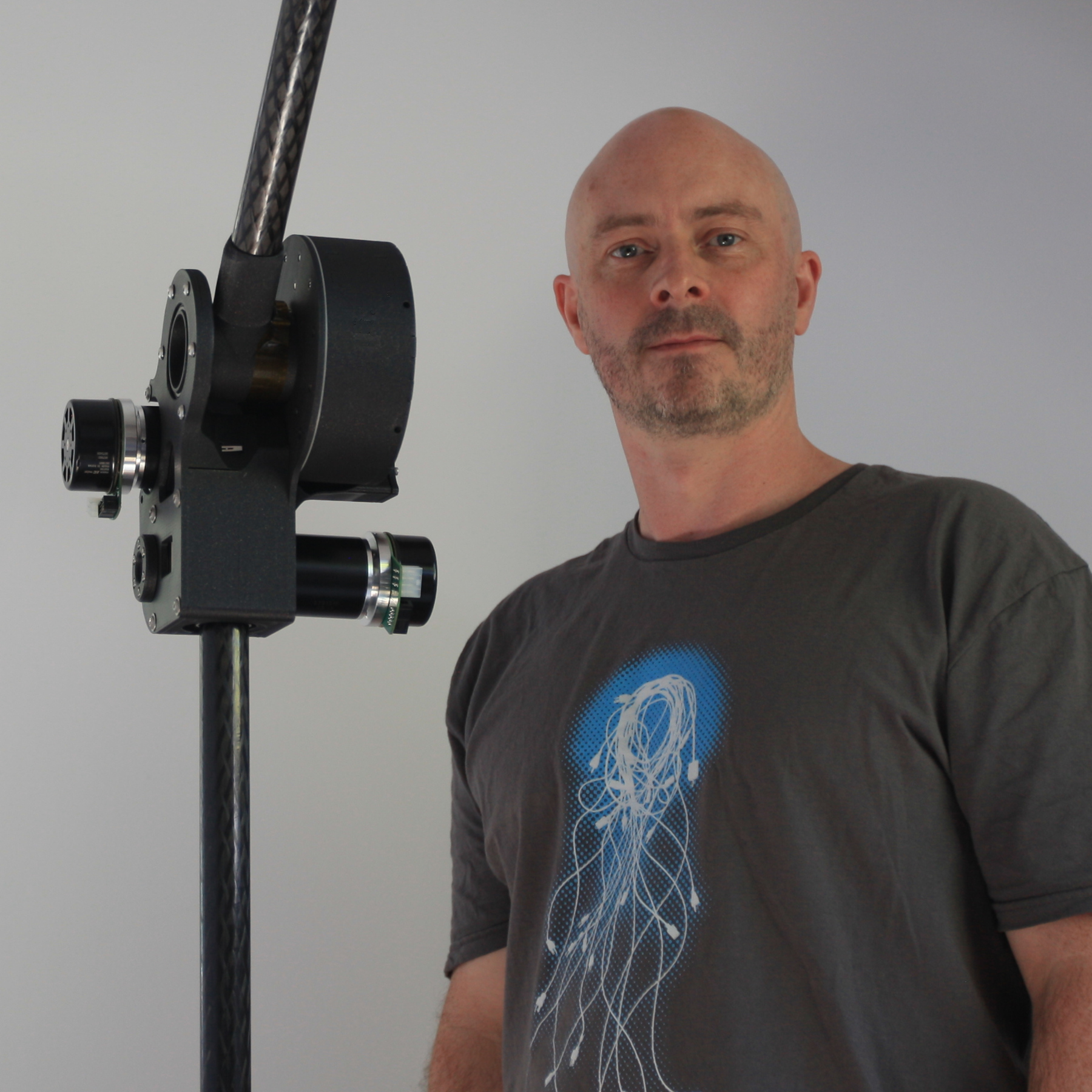
We got ARIA Seed Creator status! This means that we have been funded by them to devlop a novel type of robot arm - we will use lighter, carbon fibre materials and sensor fusion to recover the accuracy.

We're setting out to research and manufacture a flexible robotic arm for collaborative robots. Traditionally, high accuracy and repeatability requires very stiff materials, increasing weight and/or expense. Andy + Chris intend to eschew stiffness in favour of lightweight, flexible materials, while overcoming the lack of accuracy with more sophisticated control systems (leveraging sensor fusion and AI). This advancement will allow for lighter, cheaper, and crucially, safer cobots, as well as having wider applications in mobile robotics. The flexibility will reduce the crush risk for collaborative humans. Ultimately, their goal is to see cobots working alongside humans, enhancing our lives.

Alghough accurate robot arms have been available since the '70s, It turns out tha this approach is very interesting


Modularity in Robotics
Adaptive Machine Patterns' ⚬Open⚬Ad-Hoc⚬ Modularity Technology

Adaptive Machine Patterns (AMP) is working on a groundbreaking modularity framework that embeds a digital twin within each robotic component, enabling truly ad-hoc assembly of robots while preserving predictable performance. Drawing on the core ideas presented in the ARIA whitepaper on Modularity in Robotics and Aron's blog post on why Modularity in Robotics is inevitable, AMP's approach translates academic concepts into a practical, openly licensed technology that can be used freely for non-commercial projects.

At the heart of the AMP system is a standardized mechanical‑electrical‑communication interface. Every module presents a uniform connector that supplies power, data, and a high-speed bus for real-time coordination. This hardware uniformity mirrors the ARIA recommendation for “plug-and-play” interoperability, allowing designers to mix and match locomotion units, sensor packs, and manipulation arms without custom wiring or firmware rewrites.

What sets AMP apart is the embedded digital twin that lives on each module’s raspberry pi controller. The twin continuously mirrors sensor readings - such as joint torque, temperature, and battery state - and streams this information to a local simulation engine. When modules are combined, their twins exchange semantic descriptors (capability tags, kinematic parameters, resource limits) and instantly synthesize a global system model. This model predicts the assembled robot’s dynamics, energy budget, and collision risk before any motion is executed, echoing Aaron’s demonstration of on-board virtual sandboxes that accelerate configuration testing.

AMP proposes this as an open ad-hoc standard, and is looking for partners released under a permissive, free commercial license for turnovers under $10M USD. By doing so, the company invites researchers, hobbyists, and educational institutions to experiment with modular robotics without navigating proprietary barriers. The standard encourages community-driven extensions - new module types, alternative control algorithms, or bespoke sensor packages - while retaining the safety guarantees of the embedded twins.

In practice, AMP’s technology empowers rapid prototyping: a developer can snap together a wheeled base, a lidar sensor, and a lightweight manipulator, watch the twins negotiate a coherent kinematic model, and launch a validated motion plan within seconds. Because the digital twins operate locally, the system remains resilient to network latency and can function in disconnected environments - a crucial advantage for field robotics and disaster- response scenarios.

By aligning with the scholarly foundations laid out in the ARIA paper and Aaron’s blog, yet extending them with an open, twin-enabled architecture, Adaptive Machine Patterns offers a compelling, community-friendly pathway to the next generation of modular robots. The technology promises to lower entry barriers, accelerate innovation, and foster a collaborative ecosystem where anyone can explore novel robotic configurations without commercial constraints.

Right now its all deeptech - but it'll come out soon - email us at amp@adaptive-machine-patterns.com to join the revolution!

As an example, the Aron-Ericsson robot arm has been designed with a modular approach - it can be easily extended with new features or components


Starting Up!
Sometimes I wonder why I choose to do what I do - why its aspirational for many, but I have never felt I had a choice.

TLDR: I do it because it is what I have done for 18 years - It is all I know how to do and I recently discovered that it isn't something that everyone can do.

Starting a company is an aspirational goal for many people, yet not everyone does it. Its very simple in the UK, but comes with plenty of responsibility. I say its easy because if you are legally able to do it in the UK, you can go through a company like 99pcompanyformations(not an endorsement) and have a company in your possession within 24 hours. However, it comes with responsibility - because then you are on the hook for tax returns and potentially an audit!

Personally, I have never been able to get ahead in a company as an employee, and I am very jealous of those people who can! (I believe that I “work too hard” looking stressed about deliverables is my way of looking like I am taking them seriously but some people see this insecurity as weakness). Walking in as the consultant or expert in a field has always given me the edge. As an employee you will be given work until you break - pushing back against that without appearing stressed it is something I never mastered.

I love the freedom, and the reward is that you actually did something - so few people can see what they achieved. Working in a small company lets you do something, solve every problem, set the world to rights and dream of how you will build it better!

Finally, a piece of advice if you are going into tech. protect your IP early. We are using Venner Shipley, they are a large global IP solicitors, and this has brought us some respect around the scene, engage someone before you sign any partnership agreements.